Cinema
Babel - Forêt

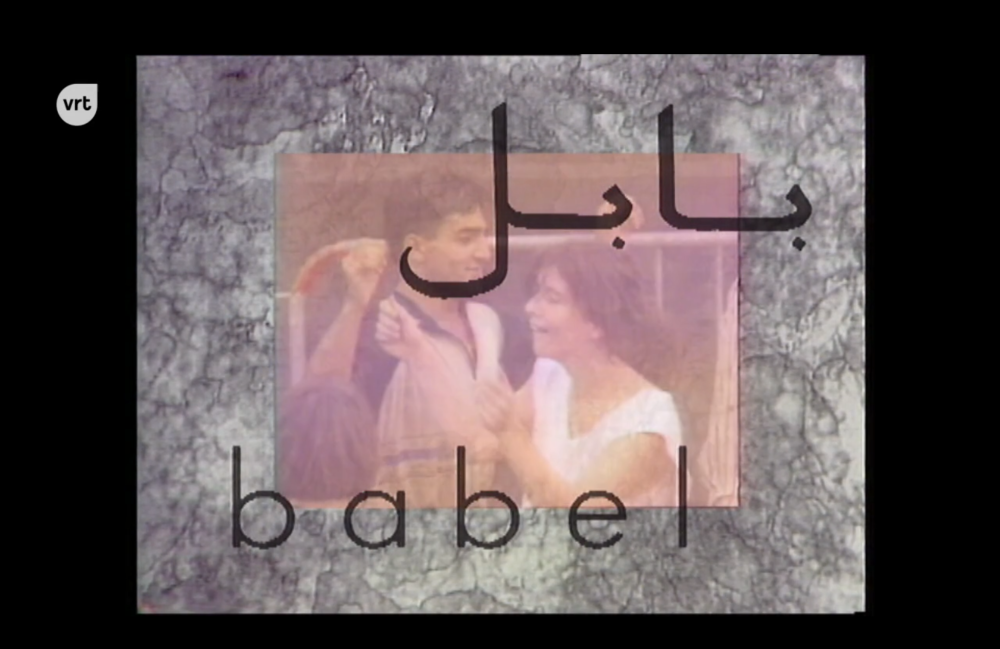
BABEL, Instructieve Omroep 1991
The Forest revolts were not as spontaneous as many people think. Nor were they built in one day. They were the result of an accumulation of injustices inflicted
on the children of immigrant workers in Brussels since the 1960s. We translated a 1991 reportage from Arabic and Moroccan Darija made by Mohamed Bouchataoui for Babel, a BRTN series targeting North African newcomers. This historical reportage shows how one, ex- tremely violent ID check can be the drop that made the vase overflow. It includes a testimony from Rachid Redouan, the first witness to the spark that ignited the fire.
Credits
- Redactie : Mohamed Bouchataoui, Mohamed El Khaldi, Mimoun Sastane
- Translation : Abdelmalek El Houari
- Regie : Mohamed Bouchataoui
- Regie-Assistentie : Gino Vanspauwen, Corinne Raes
- Editing : Bart Sels, Marc Voets
- Production : Bert Govaerts
New Translation
by Fayruz Yousfi (2022)
Journalist 1 & 2: “Good afternoon, dear viewers. Assalamu Alaykoum and welcome. In this program, we will discuss a special topic, the events that happened in some neighborhoods of Brussels. The program will end with the song Word’s Secrets from the band Wachm. But let’s start with this week’s news.”
Journalist 2: “In May 1990, permission was granted to the city council of Liege, which resulted in the council refusing to register migrants who were not from the European Union. This settlement is part of decision 18 from the GOL law, which ended now. The minister of Justice refused to extend it. Thus, the city council of Liege is now obliged to register non-European Union migrants. Mister Gol, the former minister of Justice, condemned the «unreasonable decision» of the current minister of Justice. Gol considers that the situation of liege has not changed to alter this decision.”
Journalist 1: “Edith Crésson, the new French chief of government, nominated a singular minister to integrate migrants. The chief of government said that migration and integration would be a priority in her new mandate.”
Journalist 2: “From May 15th, 1990, Spain has now obliged Maghrebi citizens to have a visa to enter its territory. Concerning tourism, the Spanish authorities are requiring Maghrebi citizens to have a two-way ticket and a budget of 5000 pesos to spend daily during their stay. As for Moroccan citizens living across the Ceuta and Melilla’s borders, they do no longer need visas to visit the two Spanish cities just a Moroccan passport. Lastly, Maghreb citizens living in the European Union do not need a visa to cross the Spanish territory.”
Journalist 1: “This week, Brussels is witnessing the same unrest between migrants and the police as other European cities. These unrests started from Forest and spread to other municipalities in Brussels. We are trying to understand as much as we can what happened. We gather testimonies from inhabitants in Forest who lived these events. We will see the summary of their testimonies in this small film report.”
Journalist 2: “These are a few images from last week's events in Place Saint Antoine and the neighboring streets in Forest. These events did not surprise anyone, but what was surprising was the place it erupted. Indeed, Forest is well-known for its good treatment of migrant communities as Ali, an inhabitant of the municipality, says.”
Interlocutor 1: “Whoever you ask will tell you that there is no issue with the municipality of Forest. Saint Gilles is different. The place where the event erupted is located between Saint Gilles and Forest. The frontier of the two municipalities.”
Interlocutor 2: “There is no issue with all administrative errands, there is no problem in this regard with the municipality. If you need to extend your residency cards or do your paper, it’s totally fine. However, our main issue is with the police.”
Journalist 1: “If everyone says that there is no issue with the municipality, then where is the problem here? And why these events? It all started last Friday at around 9 pm with an argument between the police and a Moroccan guy, Rachid Redouane.”
Interlocutor 3: “It was Friday afternoon, I parked my motorcycle in the square. I even left my coat on it. I wanted to have a cup of tea just nearby, but I saw a police officer of Forest issuing me a fine. I left the bar and asked them what the reason for the ticket was. They said they give me a ticket because my motorcycle’s license plate is not showing.”
Journalist 1: “After a few arguments, the officers wanted to take Rachid to the police station. But Rachid ran to his place, to go and get his father and sisters. After a heated debate, the police officers violently beat Rachid.”
Interlocutor 3: “They grabbed my shoulder and kicked me with batons on my back. Then my sister came and asked them to stop. She is 25 years old. They beat her on her back and in her stomach too. We had to take her urgently to the hospital.”
Journalist 1: “The incident that happened to this young man and his family last Friday is not an isolated case. In Forest, it happened several times already. Many people complain about the police's behavior in the neighborhood.”
Interlocutor 4: “It all started during Ramadan. Like usual, we hang out in different cafés around Forest. Two or three officers, well known, approach and harass us.”
Interlocutor 5: “Some police officers are well known, and they are the troubled ones. They would come and ask for your papers in a not so respectful way. When you give them your ID card, they start pushing, body search and harass you. They try to provoke you and see how you are going to respond.”
Interlocutor 6: “It’s a nightmare every time I must go to the police station. They will always talk bad to us and humiliate us. They do not have humanity.”
Police Officer: “I refute the specific relations between Forest's police and the youth of the neighborhood. That does not mean that some police officers had at some point problems with some youth of the neighborhood. I do not deny it, and it is always possible and probably accurate. But when the police force of Forest has a different behavior towards the youth of this neighborhood, I say no.”
Interlocutor 7: “My wife is Belgian, my children are Belgian, and I have Belgian nationality. Today, I went to the police station in Rue de Liège. I'll tell you about racism. I gave them my Belgian ID and asked for the certificate "bonne vie et mœurs". When he found that I have Tunisian background, he said, "your country is misery." I said: “my country is Belgium; I am Belgian.”
Interlocutor 8: “Some police officers of Forest indeed look for fights, as everyone said, as he said, three police officers control people's papers. Just randomly.”
Journalist 1: “If what Forest's citizens say about police officers' behavior is true, public security officials argue that the police are trying to keep the neighborhood safe, especially amid youth's drug dealing.”
Interlocutor 5: “The police should do their work and keep us safe, but they need to have proof before arresting someone. If they catch someone dealing, they have proof against him. Then they should enforce the law. They cannot do this just randomly.”
Interlocutor 2: “They can do their job, but not like that. Not by beating and hitting our youth.”
Interlocutor 9: “No one is saying that the police should not do their job. Of course, they should. But this does not entail harassing the youth of the neighborhood and asking for people's papers every 5 minutes. That is not their job.”
Journalist 1: “If police surveillance increases in Forest, it is probably due because youth spend their time in the streets and have nowhere else to go. They do not have access to sports clubs. Even the public swimming pool was sold to private investors and turned into a fancy nightclub that does not let migrants in.”
Interlocutor 3: “We used to have here a swimming pool, but they turned it into a nightclub for rich people. You only see people with fancy cars, Mercedes, Ferrari etc. It is not for us. They do not allow us in there.”
Interlocutor 8: “Some people said that it is revenge against the swimming pool. It's impossible. How can I say it? The nightclubs are for rich people. They go in and vomit in the square before they leave.”
Interlocutor 5: “This nightclub brings a lot of noise. When it used to be a public swimming pool, the youth and people from the neighborhood used to swim. Now, with this nightclub for rich people, it does not even let us sleep.”
Journalist 1: “The municipality of Forest only has one youth center that tries to organize cultural and sport events. However, it is a small youth center with limited resources. As Tahar Bensaleh, a monitor in the youth center, argued.”
Interlocutor 10: “The problem is that we have a lot of demands, but we cannot organize everything. We are doing our best to find other options and organize different activities. We even contacted schools nearby to host our activities there two or three hours per day or week.”
Journalist: “In a press conference about Forest's events, the interior minister says that whatever the police does, it should not be an excuse to use tear gazes against them.”
Interior Minister: “If you let hundreds of young people, let alone thousands of young people, stroll along the streets for days on end, unaccompanied, without doing anything about it, so you get them in all languages, colors, races and nationalities, sooner or later you get difficulties with them. That is what is happening to us now. But, no mistake, even if one were made, can justify throwing Molotov cocktails and things like that.”
Interlocutor 1: “Violence was never an answer to these issues. Especially these kinds of problems. In different municipalities, Forest and many others. It's a national problem. We are talking about social problems. They could have tried to open a dialogue with the people of the municipality after these events. Of course, all of this is rooted in political problems and related to the way the Belgian state treats these communities. It can only be solved with political will, through a dialogue with the concerned, the Maghrebi migrants. Not with Moroccan or foreign authorities who are not concerned by these issues.”
Journalist 1: “That is why a committee with the parents and the youth of the neighborhood saw the day of light. Mister Laarbi is one of the members of this committee.”
Interlocutor 11: “We had a meeting with the Mayor and talked about the events that happened. And we decided to organize ourselves and try to keep this neighborhood safe.”
Journalist 2: “What decision did you reach with the Mayor?”
Interlocutor 11: “The Mayor agreed to reduce police patrols in the neighborhood. She will also help us with other things that have yet to be decided. But the most important thing is the reduction of police patrols to avoid new altercations.”
Journalist 2: “And the elderly and the youth all listen to you? You don’t have any issue with them?”
Interlocutor 11: “No, now they listen to us. They understood that something was happening against them.”
Journalist 1: “While all was relatively calm in Forest, a young Moroccan man died Tuesday. He lived 100 meters from the square where the events erupted. At the same time, hostile groups distributed anti-migrants flyers. This only confirms the implication of foreign groups with specific agendas who want to take advantage of these events.”
Interior Minister: “Yesterday evening, so I'm not talking about Friday, I'm not talking about Saturday. But that last night, one could already see a few familiar faces from the Vlaams Blok milieu and a familiar face from the Old Westland New Post dossier popping up near the Saint Antonius’ place. Yes. But I'm not saying that's their work. I'm saying that. If there's a cadaver somewhere, certain species of animals will flock to it, of course. That's always the case.”
Interlocutor 1: “If there are political gains from these events, then it will probably benefit political professionals. Say political leaders, parties, officials and members of parliament. I am not aware nor concerned about this. If it happens, it will most probably benefit Belgians. I don't see any Moroccan in the circle of power.”
Interior Minister: “Well, I think there are two kinds of people who have an interest in this kind of development. That is, on the one hand, the Belgians who build their political successes on racist motives and, on the other hand, within that community, the fundamentalists who refuse and want to prevent any form of integration in that community.”
Interlocutor 1: “It's an accumulation of different forms of exclusion and social violence. It is a problem at the municipality level and educational level, a failure in education, unemployment, etc. The young Moroccan man lost his identity. He cannot find his cultural identity. As a person, that should be respected culturally and socially. All these accumulations can lead to an explosion. And in this case, this explosion occurred when the police violently checked the young man's paper. This was the straw that broke the camel's back. It's not spontaneous but a consequence of accumulations.”
Journalist 1: “The news about the young Moroccan man’s death and the right wing’s mobilization in Molenbeek travelled in the capital. It sparked altercations in the municipality of Saint-Josse, Schaerbeek and Molenbeek, where people attacked police officers.These events showed that there is great dissatisfaction with some police officer’s behaviors and harassment against immigrants. As Forest's council president said, these behaviors result from the working condition of the police corps.”
Mayor of the municipality of Forest: “Of course, on a corps of 140 men, with a normal capacity of 190. Those people are tired, they have to work during the weekends, for a low salary. The salary of police officers is not so brilliant. They need a degree of general secondary education and in Brussels they have to pass the second language exam, level 2. They need a high level for little money, so it is possible people are sometimes nervous. You also have a part of provocation on the other side. An old thing, sometimes also the police officers are a little...surprised.”
Interlocutor 12: “One day, I left the metrostation in Lemonier; two gendarmes were following us when we left the metro and wanted to take the tram. They didn't ask to see our tickets. They waited until we took the tram to control us and ask for our tickets. If he said it before, we would have said that he just wanted to control us, and he has all the right to do so. But the fact that he waited until we were in the tram wasn't innocent.”
Journalist 1: “To avoid these events, the interior minister took multiple decisions: hiring police assistants from the migrant community.”
Interior Minister: “In the police forces in cities like Brussels, Antwerp and so on. we could very well use people coming from a Maghrebi milieu. We have opened the possibility of recruiting contractuals, also recruiting non-Belgians contractuals, as auxiliary agents. For example, it would have been very useful yesterday evening at around 6 p.m. if someone gave a speech at Saint- Anthonius’ Square in front of the young immigrants present there. Yes, it would have been particularly practical at that time to have someone in the police who understood what this guy was saying.”
Interlocutor 9: “Here the police don’t do their job. They are never here when you need them.”
Journalist 2: “Following these events, the minister of Interior and the minister of Justice took measures to prevent similar events from happening in the future.”
Journalist 1: “The Minister of Justice announced that from now on, the perpetrators of these crimes (burning of cars and riots) would be brought before a judge rapidly. In less than ten days. These speedy trials would apply to criminals who have confessed their crimes or have been arrested while committing a crime.”
Journalist 2: “As for the interior minister, he presented a note to the cabinet regarding Forest's riots. The interior minister said in his note that the officials had omitted migrant's communities’ education. If people are educated, they will have adequate training to find a job. Since the educational system isn't adequate, it leaves them with no job, increasing their marginalization and pushing them into drug traffic.”
Journalist 1: “He also said that he could not leave the neighborhood without police patrols nor put the officers' lives at risk. The minister allocated 50 million francs to hire police assistants in the communities with high population of migrants. He added that he is thinking about training police officers and gendarmes about migration and migrants to facilitate the communication between the police and immigrants. He added in his note that the security approach is not enough. There is also a need to improve housing, education, and cultural life. These were some pieces of information about Forest's events. Before leaving you to music, here are some advertisements.”